您的位置: 首页 > 2025年月 第卷 第Articles In Press期 > 文字全文
2023年7月 第38卷 第7期11
目录

A machine-learning-based bibliometric analysis of the scientific literatures on orthokeratology

A machine-learning-based bibliometric analysis of the scientific literatures on orthokeratology

来源期刊: Eye Science | 1-21 发布时间: 收稿时间:2025/11/25 16:22:03 阅读量:87
作者:
关键词:
orthokeratology bibliometric analysis myopia control
DOI:
10.12419/es25031306
Received date:
 
Revised date:
 
Accepted date:
 
Published online:
 
Objective: This study aimed to analyze the research hotspots and frontiers in orthokeratology using bibliometric methods, providing a scientific and precise reference for both new and established researchers.Methods: A bibliometric analysis was conducted on literature related to orthokeratology over the past three decades within the Web of Science Core Collection (WoSCC).  Analytical tools available in the R software environment were employed, integrating a machine learning-based bibliometric approach.Results: A total of 740 articles concerning orthokeratology research were retrieved from the WoSCC. Research on orthokeratology has shown a consistent upward trend, with an annual growth rate of 18.75%. China, Australia, and the United States are the most prolific countries in this field, with China making the largest contribution. The journals with the highest number of publications are Optometry and Vision Science (n=110), Contact Lens and Anterior Eye (n=96), and Eye & Contact Lens (n=72. Meanwhile, Pauline Cho (n=76) and Cheung SW (n=47) are the most active authors. Over the past three decades, common keywords in research literature have highlighted key areas, including corneal reshaping in pediatric populations, the prevalence and progression of myopia, contact lenses, refractive errors, and changes in axial length.Conclusions: In summary, this bibliometric analysis presents a comprehensive overview of the current state of orthokeratology research. It aids in gaining a better understanding of how  this field has developed over the past 30 years.

HIGHLIGHTS

1.Critical Discoveries and Outcomes

Global orthokeratology research has exhibited a steady upward trend over the past three decades, with China emerging as the leading contributor and research emphasis shifting from refractive correction and safety toward pediatric myopia control and axial length regulation.

2.Methodological Innovations

This study applied a machine-learning-based bibliometric framework using R-based visualization to uncover evolving research hotspots, author collaboration networks, and thematic transitions across orthokeratology literature.

3.Prospective Applications and Future Directions

The findings offer data-driven insights supporting AI-assisted, personalized ortho-k lens design and encourage interdisciplinary integration for advancing future myopia-control strategies.

INTRODUCTION

The global prevalence of myopia has been on the rise in recent years.[1-2]Once myopia begins to develop, it is irreversible. To reduce the occurrence of associated visual complications in myopia patients, conducting in-depth research into effective myopia control strategies has emergd as a major public health goal.[3]Orthokeratology lenses (ortho-k) are reverse-geometry lenses specifically designed to enhance unaided vision after being worn overnight. With over 30 years of clinical application, there is substantial evidence indicating that ortho-k plays a role in controlling axial length growth in children.[4]However, the efficacy of myopia control with these lenses varies greatly among individuals, and the underlying mechanisms are still not well-understood. Moreover, considering the growing volume of relevant literature and data resources, effective information discovery and knowledge mining are of utmost importance. These processes are essential for uncovering the background, driving forces, and development trajectory of research and development in ortho-k studies. This, in turn, is required to reveal the inherent characteristics and patterns of development in this field. Bibliometrics is a scientific quantitative approach that integrates library science, mathematics, and statistics. It is used to analyze the distribution structure, quantitative relationships, and patterns of change in scientific literature information. Bibliometrix is a software package based on the R programming language, specifically designed for bibliometric analysis and visualization. It can organize and analyze literature information from databases like Web of Science, calculate relevant parameters, construct data matrices, and perform analysis and visualization on aspects such as keyword co-occurrence, literature co-citation, and historical literature citation. Compared to software packages such as CiteSpace and VOSviewer, Bibliometrix offers more comprehensive functionality.

To gain a comprehensive understanding of the current state of ortho-k research, pinpoint research hotspots within the field, and delve into its developments and trends, this study employed bibliometric methods. It searched the Web of Science Core Collection database (WoSCC) for relevant literature spanning from 1995 to 2023. In a bid to quickly review the research status of this field and dissect the evolving trends of research hotspots, the study conducted bibliometric and visual network analyses. These analyses focused on various aspects, including the overall status of literature, authors, institutions, countries/regions, keywords and the like.

METHODS

Bibliometric database

The WoSCC was chosen due to its extensive and comprehensive data. This data not only satisfies the requirements of bibliometric software but also positions it as one of the most authoritative and influential databases in this particular research field. Considering that the data for this study were directly obtained from public databases, obtaining ethical approval  was deemed unnecessary.

Eligibility criteria

This study focused on literature centered around ortho-k as the research subject. The article types were restricted to “article” and “review.” Conference abstracts, letters, expert views, editorial materials, corrections, retractions, and proceedings papers were all excluded. All the publications incorporated into the study were gathered from the WoSCC database on December 31, 2023. The search formula was configured as follows: TS = (orthokeratology lens OR ortho-k OR corneal reshaping contact lens OR corneal reshaping OR OK lens OR orthokeratology lenses OR corneal plastic lens OR ortho-k lens OR orthokeratology contact lens OR ortho-k lenses). The time frame for the published studies under evaluated was set from 1995 to 2023, and the language was limited to English. Records were excluded under the following circumstances: if they were not related to orthokeratology (for example, those solely focusing on myopia without any ortho-k intervention); if they were editorial materials, letters, meeting abstracts, conference proceedings, or corrections; or if they lacked crucial bibliographic information such as title, authorship, or publication year. Two researchers,FF F and J Wang, cross-checked the articles that were included. In cases where there were disparities, researchers YJ Xie and Xiaoxiao Zhang  made the final decision.

Data analysis

The outcomes of the database search were exported, encompassing a wealth of  bibliographical information. This included details such as the authors, abstracts, keywords, affiliations, and funding sources. Additionally, citation-related information was also included, covering citation authors, document titles, document types, years of publication, sources, volumes, pages numbers, citation counts,and other pertinent details. A machine-learning bibliometric approach was employed to assess the distribution of each factor. For the in-depth analysis, the Bibliometrix R package was utilized to conduct a comprehensive assessment.

RESULTS

Overview and  publications

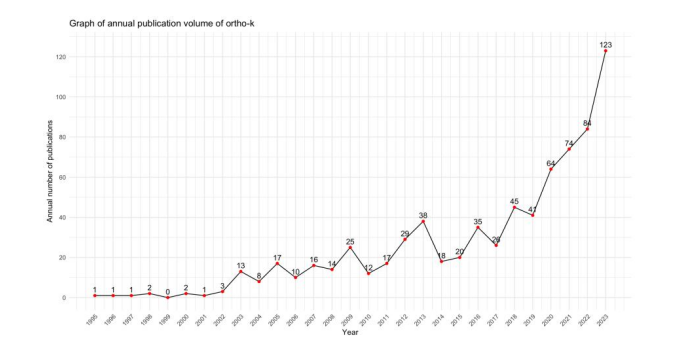
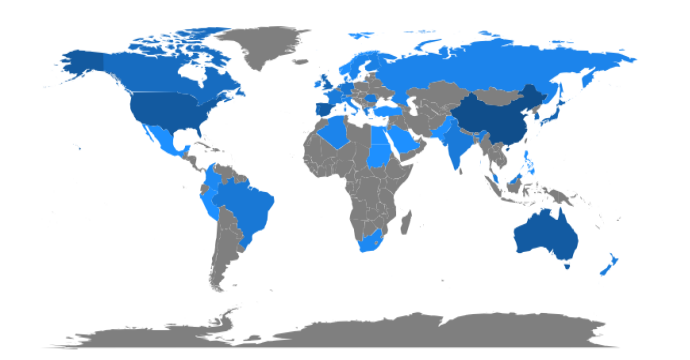
The search strategy yield a total of 740 studies and reviews. These articles were published across 123 journals, exhibiting an annual growth rate of 18.75%. The average age of the literature stood at 7.16 years, and on average, each article received 21.44 citations. Moreover, the cumulative number of references cited in these studies reached 9,867. Over the past three decades, there has been a consistent year-on-year increase in both the number of publications and citations of ortho-k articles. In 2022 and 2023, the number of publications of related articles reach a  peak, with 123 articles published in each year  ( as shown in Figure 1). The three countries with the highest output were China, Australia, and USA. The country-specific publication output is depicted in Figure 2 (the blue zone).

Figure 1. Annual publication volume of ortho-k.

Figure 1. Annual publication volume of ortho-k.

Figure 2. Country-specific production.

Figure 2. Country-specific production.
The color intensity is proportional to the number of documents. Higher blue intensity refers to greater number of documents (dark blue = high productivity; grey = no documents).

Documents and authors

In the domain of academic journals, Optometry and Vision Science took the lead, having published 110 articles, which represented the highest publication count among all sources. Contact Lens and Anterior Eye came in a close second, making a substantial contribution with 96 articles. Noteworthy contributions also originated from journals like Eye & Contact Lens, Science and Clinical Practice, Ophthalmic and Physiological Optics, and Investigative Ophthalmology & Visual Science. Among the authors who have made siginificant contributions Pauline Cho and Cheung SW stand out. Upon analyzing their contributions, it becomes evident that Pauline Cho was  the most prolific author, with 76 published articles, accounting for 10.3% of the total number of publications. Cheung SW followed closely behind, having authored 47 articles, which made up 6.4% of the total. Although Cheung SW’s publication count was lower than that of Pauline Cho, his  contributions still hold considerable weight within the academic community. Furthermore, our analysis revealed other active authors in the field, including González-Méijome, JM, Villa, C and Swarbrick, HA (as shown in Table 1).

Table 1. Top journals and authors in Ortho-K research.

Sources

Articles

Authors

Articles

Optometry and Vision Science

110

Pauline Cho

76

Contact Lens and Anterior Eye

96

Cheung SW

47

Eye & Contact Lens

72

González-Méijome JM

33

Ophthalmic and Physiological Optics

46

Villa C

30

Investigative Ophthalmology & Visual Science

36

Swarbrick HA

24

Cornea

26

Chen Z

24

Clinical And Experimental Opto-metry

23

Queirós A

20

BMC Ophthalmology

23

Zhou XT

19

Current Eye Research

22

Paul Gifford

18

Journal Of Ophthalmology

14

Jiang J

18


Among the multitude of publications, the research study titled “Retardation of Myopia in Orthokeratology (ROMIO) Study: A 2-Year Randomized Clinical Trial”stands out. Authored byPauline Cho and published inInvestigative Ophthalmology & Visual Science in 2012, this study has achieved the highest citation count, amassing a total of 470 citations. It maintains animpressiveaverage citation rate of 36.15 per year,alongwith a standardized citation rate of 10.81. These figures firmly establish it as one of the most impactfularticles in the field. The second mostfrequentlycited articleis the meta-analysis “Efficacy Comparison of 16 Interventions for Myopia Control in Children”. Authored by Huang JH and published in theOphthalmology Journal in 2016,it has garnered a total of 419 citations.

Keywords and trends

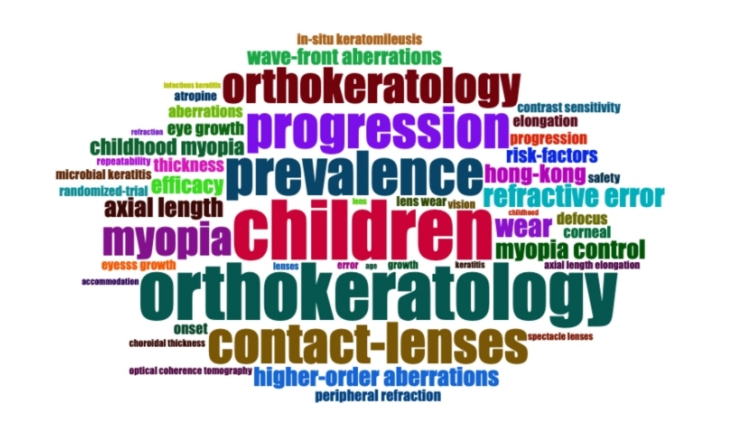
Keywords also serve as indicators of the boundaries and emerging topics within a particular field. The most frequently occurring keywords in the research literature were brought to the forefront using the word-cloud method. This method visually represented the frequency of word repetition in the sample data (as shown in Figure 3). In the selected sample, the more often a word was mentioned, the larger its sizes appeared in the world cloud. The top-rank keywords, which had the highest occurrence frequencies in the analyzed articles, revealed a strong focus on corneal reshaping in pediatric populations, with 186 occurrences. The predominant areas of investigation included the prevalence of myoia , with 138 occurrences and progression, with 130 occurrences. Additionally, there were considerations regarding the use of contact lenses and refractive errors. Furthermore, researchers are paying close attention to changes in axial length, a parameter that is conventionally associated with myopia development. These findings highlight the prevailing research priorities and the most prominent areas of interest within the field of ophthalmology. Consequently, they provide crucial reference points for future research endeavors.

Figure 3. Keywords word cloud.

Figure 3. Keywords word cloud.

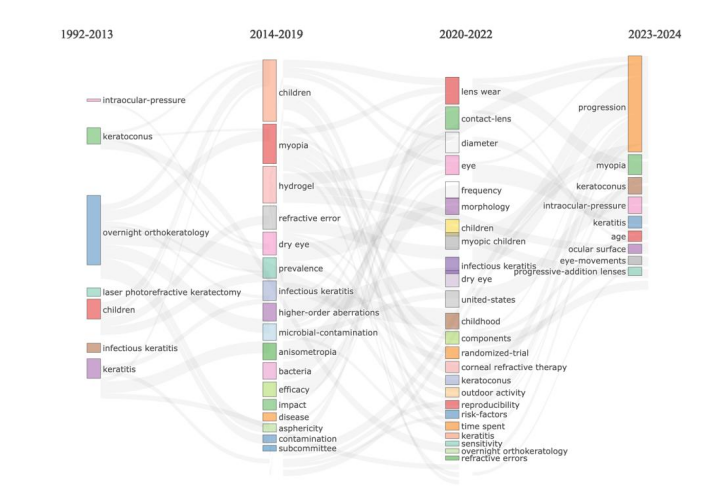
The findings derived from the thematic evoluation analysis of the keywords reveal  the major thematic shifts within the fields of children’s vision problems, adolescent myopia, infectious keratitis, intraocular pressure, dry eye, and keratitis from 1995 to 2019 (as depicted in Figure 4). During the period from 1995 to 2013, the research focus was predominantly concentrated on children’s vision problems and infectious keratitis. In contrast, from 2014 to 2019, the research scope broadened significantly, encompassing a wider range of areas, including adolescent myopia, intraocular pressure, and dry eye research.

Figure 4. Thematic evolution analysis of keywords in ortho-k research.

Figure 4. Thematic evolution analysis of keywords in ortho-k research.

DISCUSSION

Ortho-k is a safe and effective procedure for both correcting refractive errors and slowing the progression of myopia.[5]Since the introduction of the first reverse geometry lens in 1989, substantial advancements in materials, design techniques, and examination equipment (such as corneal topography) have propelled this technology to uprecedented levels.[6]In 2002, the U.S. Food and Drug Administration (FDA) approved an overnight ortho-k design, extending its use to all age groups and enbaling corrections for refractive errors up to -6.00 D.[7]Marketed as corneal refractive therapy, this approval breathed new vitality into the industry. Subsequently, numerous companies entered the ortho-k market, introducing innovative lens designs and materials. This diversification has facilitated greater customization, enhancing lens centration and accommodating more complex prescriptions. Factors such as overnight wear, higher oxygen permeability, computer-aided lens designs, and accelerated treatment outcomes have contributed to the rising popularity of ortho-k among eye care professionals and the general public.[8]

Moreover, international collaboration and information sharing have become more readily accessible, fostering a cooperative environment for researchers across borders. This exchange of knowledge and expertise has likely contributed to the increased number of articles on ortho-k, with researchers worldwide collectively advancing the understanding of its benefits, limitations, and potential breakthroughs in the field. This also accounts for the  noticeable year-on-year growth trend in ortho-k related articles since 2005.

Interestingly, we discovered that although ortho-k originated in the United States and initially received approval from the FDA, China has become the country with the highest number of publications on related research. This can be attributed to several factors. Firstly, it has been reported that the prevalence of myopia in East Asian countries can reach as high as 90%.[5]This issue is particularly severe in China, which has led to a significant emphasis on innovative solutions for vision correction.[4,9-11]Ortho-k, offering non-invasive and reversible options for myopia control, has attracted substantial attention from researchers as a potential solution to address this widespread problem. In the United States, it is estimated that there are between 500,000 and 1000,000 users of ortho-k, while in China, the number of ortho-k wearers may be as high as 1.5 million.[12]Secondly, China has witnessed rapid advancements in its research infrastructure and funding in recent years. Increased investment in the field of ophthalmology and vision research has enabled Chinese researchers to conduct more extensive studies, resulting in a higher volume of publications.[13-14]Furthermore, China’s large and diverse patient population provides researchers with ample opportunities to conduct clinical trials and studies, facilitating a comprehensive understanding of the efficacy and applicability of ortho-k among different demographic groups.

Among the numerous studies from China, the performance of two scholars, Pauline Cho and Cheung SW, is particularly remarkable, as they have published the highest number of articles. These two most highly active authors are from the same institution (Department of Optometry & Radiography, The Hong Kong Polytechnic University, Hong Kong, SAR, China) and have co-authored many publications. Further analysis revealed that the studies by Pauline Cho et al.[15]and Swarbrick, HA et al.[16]have had the most profound influence on other scholars. Nevertheless, they mainly focused  on two distinct viewpoints within the ortho-k field: Swarbrick et al.’s articles attempted to elucidate the effectiveness of ortho-k treatment for refractive error correction, while Cho et al.’s studies delved into myopia  control. Notably, in line with the theme of myopia control, Swarbrick et al. pioneered research in 1998 that examined the corneal response to ortho-k.[16]Subsequent studies by Swarbrick et al. shifted their focus to the safety of ortho-k, such as the incidence of microbial keratitis.[17]We also found that Swarbrick et al. authored six of the nineteen safety and efficacy-related papers that met our inclusion criteria.[16-27]Upon detailed analysis of all the papers by Cho et al., we identified eight studies within the myopia control category, with six of these originating from the same institution.[28-32]As leading figures in the ortho-k field, these researchers degan documenting their daily clinical insights in chronological order. In 2004, they revealed their findings on the impact of ortho-k on eye axial length.[31]The pinnacle was reached in 2005 when Cho et al. published the highly cited LORIC study, which has since become a benchmark in utilizing ortho-k as a method for myopia control.33

Whether we are analyzing the relationship between these authors and keywords or examining the keywords on an individual basis, we have identified a common trend in these studies. It is readily observed that over the past nearly 30 years, research on ortho-k has gradually shifted its focus. Initially, concerns centered around “refractive error,” “wear,” and “safety” to topics such as “children,” “prevalence,” “progression,” and “myopia.” With the growing popularity of ortho-k, both patients and clinicians have noticed a significant decrease in the progression of myopia.[33]This trend became even more apparent following the first randomized controlled trial conducted by Pauline Cho and Cheung SW. Their study compared axial length changes between ortho-k and single-vision spectacle wear.[28]Subsequently, a large number of studies, along with meta-analysis studies, have confirmed these findings.[34-36]More recently, with advancements in technology and accumulated clinical experience, there has been a rising interest in enhancing myopia control through personalized ortho-k designs. These designs include using a smaller treatment zone size, altering the back optic zone asphericity, and increasing the compression factor.[37-39]Moreover, artificial intelligence-assisted lens fitting methods, which are based on corneal topography, have demonstrated improved precision in predicting optimal lens parameters. This offers a more efficient and individualized approach to orthokeratology treatment.[40]In parallel, clinical studies have provided compelling evidence that combining 0.01% atropine with ortho-k lenses yields greater efficacy compared to monotherapy, especially in younger children.[41]Additionally, emerging research on corneal biomechanics suggests that indices such as the Corvis Biomechanical Index (CBI) may serve as early predictors of the response to ortho-k treatment. However, their long-term association with axial elongation still needs to be fully elucidated.[42]

CONCLUSION

This study conducted an in-depth analysis of ortho-k research published between 1995 and 2023. We systematically summarized the regional distribution, journal categories, and keyword clustering patterns associated with ortho-k research. As previously discussed, ortho-k has proven to be a safe and effective approach for slowing down the progression of myopia in children. However, further clinical investigations are obsolutely essential to validate methods aiming at optimizing the efficacy of ortho-k in myopia management. The findings of this study offer crucial insights into the current landscape of ortho-k research. Moreover, they serve as an invaluable resource for scholars seeking to identify key research themes and emerging trends in this field.

CORRECTION NOTICE

None

ACKNOWLEDGEMENTS

None

AUTHOR CONTRIBUTIONS

(I) Conception and design: Jianhui Chen, Xiaoxiao Zhang
(II) Administrative support: Jianhui Chen, Xiaoxiao Zhang
(III) Provision of study materials or patients: Yicui Weng, Feifan Fu
(IV) Collection and assembly of data: Can Chen, Yaojue Xie, Jian Wang
(V) Data analysis and interpretation: Can Chen, Yaojue Xie, Jian Wang, Xiaoxiao Zhang
(VI) Manuscript writing: All authors
(VII) Final approval of manuscript: All authors

FUNDING

This work was supported byGuangzhou Aier Eye Hospital Science Foundation for Youths (GA2023003)

CONFLICT OF INTERESTS

None of the authors has any conflicts of interest to disclose.All authors have declared in the completed the ICMJE uniform disclosure form.

PATIENT CONSENT FOR PUBLICATION

None

ETHICS APPROVAL AND CONSENT TO PARTICIPATE

None

DATA AVAILABILITY STATEMENT

None

OPEN ACCESS

This is an Open Access article distributed in accordance with the Creative Commons AttributionNonCommercial-NoDerivs 4.0 International License (CC BY-NC-ND 4.0), which permits the non-commercial replication and distribution of the article with the strict proviso that no changes or edits are made and the original work is properly cited (including links to both the formal publication through the relevant DOI and the license).
1、1. Vitale S, Sperduto RD, Ferris FL 3rd. Increased prevalence of myopia in the United States between 1971-1972 and 1999-2004. Arch Ophthalmol. 2009, 127(12): 1632-1639. DOI: 10.1001/archophthalmol.2009.303. 1. Vitale S, Sperduto RD, Ferris FL 3rd. Increased prevalence of myopia in the United States between 1971-1972 and 1999-2004. Arch Ophthalmol. 2009, 127(12): 1632-1639. DOI: 10.1001/archophthalmol.2009.303.
2、2. Holden BA, Jong M, Davis S, et al. Nearly 1 billion myopes at risk of myopia-related sight-threatening conditions by 2050 - time to act now. Clin Exp Optom. 2015, 98(6): 491-493. DOI: 10.1111/cxo.12339. 2. Holden BA, Jong M, Davis S, et al. Nearly 1 billion myopes at risk of myopia-related sight-threatening conditions by 2050 - time to act now. Clin Exp Optom. 2015, 98(6): 491-493. DOI: 10.1111/cxo.12339.
3、3. Holden BA, Fricke TR, Wilson DA, et al. Global prevalence of myopia and high myopia and temporal trends from 2000 through 2050. Ophthalmology. 2016, 123(5): 1036-1042. DOI: 10.1016/j.ophtha.2016.01.006. 3. Holden BA, Fricke TR, Wilson DA, et al. Global prevalence of myopia and high myopia and temporal trends from 2000 through 2050. Ophthalmology. 2016, 123(5): 1036-1042. DOI: 10.1016/j.ophtha.2016.01.006.
4、4. Lipson MJ, Brooks MM, Koffler BH. The role of orthokeratology in myopia control: a review. Eye Contact Lens. 2018, 44(4): 224-230. DOI: 10.1097/ICL.0000000000000520. 4. Lipson MJ, Brooks MM, Koffler BH. The role of orthokeratology in myopia control: a review. Eye Contact Lens. 2018, 44(4): 224-230. DOI: 10.1097/ICL.0000000000000520.
5、5. Chan B, Cho P, Cheung SW. Orthokeratology practice in children in a university clinic in Hong Kong. Clin Exp Optom. 2008, 91(5): 453-460. DOI: 10.1111/j.1444-0938.2008.00259.x. 5. Chan B, Cho P, Cheung SW. Orthokeratology practice in children in a university clinic in Hong Kong. Clin Exp Optom. 2008, 91(5): 453-460. DOI: 10.1111/j.1444-0938.2008.00259.x.
6、6. Vincent SJ, Cho P, Chan KY, et al. BCLA CLEAR - orthokeratology. Contact Lens Anterior Eye. 2021, 44(2): 240-269. DOI: 10.1016/j.clae.2021.02.003. 6. Vincent SJ, Cho P, Chan KY, et al. BCLA CLEAR - orthokeratology. Contact Lens Anterior Eye. 2021, 44(2): 240-269. DOI: 10.1016/j.clae.2021.02.003.
7、7.Food and Drug Administration. Summary of safety and effectiveness data of paragon CRT. Available at: http://www.accessdata.fda.gov/cdrh_docs/pdf/ P870024S043b.pdf. Accessed December 13, 2017.7.Food and Drug Administration. Summary of safety and effectiveness data of paragon CRT. Available at: http://www.accessdata.fda.gov/cdrh_docs/pdf/ P870024S043b.pdf. Accessed December 13, 2017.
8、8.Morgan P, Woods C, Tranoudis I, et al. International contact lens prescribing in 2016. Contact Lens Spectr 2017;32:30-35.8.Morgan P, Woods C, Tranoudis I, et al. International contact lens prescribing in 2016. Contact Lens Spectr 2017;32:30-35.
9、9. Wang J, Ying GS, Fu X, et al. Prevalence of myopia and vision impairment in school students in Eastern China. BMC Ophthalmol. 2020, 20(1): 2. DOI: 10.1186/s12886-019-1281-0. 9. Wang J, Ying GS, Fu X, et al. Prevalence of myopia and vision impairment in school students in Eastern China. BMC Ophthalmol. 2020, 20(1): 2. DOI: 10.1186/s12886-019-1281-0.
10、10. Zhao X, Lu X, Yu L, et al. Prevalence of myopia and associated risk factors among key schools in Xi’an, China. BMC Ophthalmol. 2022, 22(1): 519. DOI: 10.1186/s12886-022-02735-x. 10. Zhao X, Lu X, Yu L, et al. Prevalence of myopia and associated risk factors among key schools in Xi’an, China. BMC Ophthalmol. 2022, 22(1): 519. DOI: 10.1186/s12886-022-02735-x.
11、11. Zhuang M, Xie H, Zhang Y, et al. Prevalence and influence factors for myopia and high myopia in schoolchildren in Shandong, China. Cent Eur J Public Health. 2022, 30(3): 190-195. DOI: 10.21101/cejph.a7158. 11. Zhuang M, Xie H, Zhang Y, et al. Prevalence and influence factors for myopia and high myopia in schoolchildren in Shandong, China. Cent Eur J Public Health. 2022, 30(3): 190-195. DOI: 10.21101/cejph.a7158.
12、12. Xie P, Guo X. Chinese experiences on orthokeratology. Eye Contact Lens. 2016, 42(1): 43-47. DOI: 10.1097/ICL.0000000000000190. 12. Xie P, Guo X. Chinese experiences on orthokeratology. Eye Contact Lens. 2016, 42(1): 43-47. DOI: 10.1097/ICL.0000000000000190.
13、13. Shan LH, An XY, Xu MM, et al. Analysis on the trend of innovation and development in the field of ophthalmology. Zhonghua Yan Ke Za Zhi Chin J Ophthalmol. 2018, 54(6): 452-463. DOI: 10.3760/cma.j.issn.0412-4081.2018.06.012. 13. Shan LH, An XY, Xu MM, et al. Analysis on the trend of innovation and development in the field of ophthalmology. Zhonghua Yan Ke Za Zhi Chin J Ophthalmol. 2018, 54(6): 452-463. DOI: 10.3760/cma.j.issn.0412-4081.2018.06.012.
14、14. Zhang XB. Data analysis of application and funding of ophthalmology projects funded by National Natural Science Foundation of China from 2010 to 2021. Zhonghua Yan Ke Za Zhi Chin J Ophthalmol. 2022, 58(5): 360-370. DOI: 10.3760/cma.j.cn112142-20211104-00520. 14. Zhang XB. Data analysis of application and funding of ophthalmology projects funded by National Natural Science Foundation of China from 2010 to 2021. Zhonghua Yan Ke Za Zhi Chin J Ophthalmol. 2022, 58(5): 360-370. DOI: 10.3760/cma.j.cn112142-20211104-00520.
15、15.P. Cho, S. W. Cheung, and M. H. Edwards, “Practice of orthokeratology by a group of contact lens practitioners in Hong Kong: part I. General overview,” Clinical and Experimental Optometry, vol. 85, no. 6, pp. 365-371, 2002.15.P. Cho, S. W. Cheung, and M. H. Edwards, “Practice of orthokeratology by a group of contact lens practitioners in Hong Kong: part I. General overview,” Clinical and Experimental Optometry, vol. 85, no. 6, pp. 365-371, 2002.
16、16.%20Swarbrick%20HA%2C%20Wong%20G%2C%20O%3F%3Fleary%20DJ.%20Corneal%20response%20to%20orthokeratology.%20Optom%20Vis%20Sci.%201998%2C%2075(11)%3A%20791-799.%20DOI%3A%2010.1097%2F00006324-199811000-00019.%2016.%20Swarbrick%20HA%2C%20Wong%20G%2C%20O%3F%3Fleary%20DJ.%20Corneal%20response%20to%20orthokeratology.%20Optom%20Vis%20Sci.%201998%2C%2075(11)%3A%20791-799.%20DOI%3A%2010.1097%2F00006324-199811000-00019.%20
17、17. Swarbrick HA. Orthokeratology review and update. Clin Exp Optom. 2006, 89(3): 124-143. DOI: 10.1111/j.1444-0938.2006.00044.x. 17. Swarbrick HA. Orthokeratology review and update. Clin Exp Optom. 2006, 89(3): 124-143. DOI: 10.1111/j.1444-0938.2006.00044.x.
18、18. Watt K, Swarbrick HA. Microbial keratitis in overnight orthokeratology: review of the first 50 cases. Eye Contact Lens Sci Clin Pract. 2005, 31(5): 201-208. DOI: 10.1097/01.icl.0000179705.23313.7e. 18. Watt K, Swarbrick HA. Microbial keratitis in overnight orthokeratology: review of the first 50 cases. Eye Contact Lens Sci Clin Pract. 2005, 31(5): 201-208. DOI: 10.1097/01.icl.0000179705.23313.7e.
19、19. Watt KG, Swarbrick HA. Trends in microbial keratitis associated with orthokeratology. Eye Contact Lens Sci Clin Pract. 2007, 33(6): 373-377. DOI: 10.1097/icl.0b013e318157cd8d. 19. Watt KG, Swarbrick HA. Trends in microbial keratitis associated with orthokeratology. Eye Contact Lens Sci Clin Pract. 2007, 33(6): 373-377. DOI: 10.1097/icl.0b013e318157cd8d.
20、20. Boost MV, Cho P. Microbial flora of tears of orthokeratology patients, and microbial contamination of contact lenses and contact lens accessories. Optom Vis Sci. 2005, 82(6): 451-458. DOI: 10.1097/01.opx.0000168587.72893.ec. 20. Boost MV, Cho P. Microbial flora of tears of orthokeratology patients, and microbial contamination of contact lenses and contact lens accessories. Optom Vis Sci. 2005, 82(6): 451-458. DOI: 10.1097/01.opx.0000168587.72893.ec.
21、21. Chen D, Lam AKC, Cho P. A pilot study on the corneal biomechanical changes in short-term orthokeratology. Ophthalmic Physiol Opt. 2009, 29(4): 464-471. DOI: 10.1111/j.1475-1313.2008.00625.x. 21. Chen D, Lam AKC, Cho P. A pilot study on the corneal biomechanical changes in short-term orthokeratology. Ophthalmic Physiol Opt. 2009, 29(4): 464-471. DOI: 10.1111/j.1475-1313.2008.00625.x.
22、22. Cho P, Cheung SW, Edwards MH, et al. An assessment of consecutively presenting orthokeratology patients in a Hong Kong based private practice. Clin Exp Optom. 2003, 86(5): 331-338. DOI: 10.1111/j.1444-0938.2003.tb03129.x. 22. Cho P, Cheung SW, Edwards MH, et al. An assessment of consecutively presenting orthokeratology patients in a Hong Kong based private practice. Clin Exp Optom. 2003, 86(5): 331-338. DOI: 10.1111/j.1444-0938.2003.tb03129.x.
23、23. Jayakumar J, Swarbrick HA. The effect of age on short-term orthokeratology. Optom Vis Sci. 2005, 82(6): 505-511. DOI: 10.1097/01.opx.0000168583.17327.6d. 23. Jayakumar J, Swarbrick HA. The effect of age on short-term orthokeratology. Optom Vis Sci. 2005, 82(6): 505-511. DOI: 10.1097/01.opx.0000168583.17327.6d.
24、24. Lum E, Golebiowski B, Swarbrick HA. Mapping the corneal sub-basal nerve plexus in orthokeratology lens wear using in vivo laser scanning confocal microscopy. Invest Ophthalmol Vis Sci. 2012, 53(4): 1803. DOI: 10.1167/iovs.11-8706. 24. Lum E, Golebiowski B, Swarbrick HA. Mapping the corneal sub-basal nerve plexus in orthokeratology lens wear using in vivo laser scanning confocal microscopy. Invest Ophthalmol Vis Sci. 2012, 53(4): 1803. DOI: 10.1167/iovs.11-8706.
25、25. Choy CK, Cho P, Benzie IFF, et al. Effect of one overnight wear of orthokeratology lenses on tear composition. Optom Vis Sci. 2004, 81(6): 414-420. DOI: 10.1097/01.opx.0000135094.15125.4c. 25. Choy CK, Cho P, Benzie IFF, et al. Effect of one overnight wear of orthokeratology lenses on tear composition. Optom Vis Sci. 2004, 81(6): 414-420. DOI: 10.1097/01.opx.0000135094.15125.4c.
26、26. Cho P, Boost M, Cheng R. Non-compliance and microbial contamination in orthokeratology. Optom Vis Sci. 2009, 86(11): 1227-1234. DOI: 10.1097/OPX.0b013e3181bbc55d. 26. Cho P, Boost M, Cheng R. Non-compliance and microbial contamination in orthokeratology. Optom Vis Sci. 2009, 86(11): 1227-1234. DOI: 10.1097/OPX.0b013e3181bbc55d.
27、27. Chen D, Lam AKC, Cho P. Posterior corneal curvature change and recovery after 6 months of overnight orthokeratology treatment. Ophthalmic Physiol Opt. 2010, 30(3): 274-280. DOI: 10.1111/j.1475-1313.2010.00710.x. 27. Chen D, Lam AKC, Cho P. Posterior corneal curvature change and recovery after 6 months of overnight orthokeratology treatment. Ophthalmic Physiol Opt. 2010, 30(3): 274-280. DOI: 10.1111/j.1475-1313.2010.00710.x.
28、28. Cho P, Cheung SW. Retardation of myopia in orthokeratology (ROMIO) study: a 2-year randomized clinical trial. Invest Ophthalmol Vis Sci. 2012, 53(11): 7077. DOI: 10.1167/iovs.12-10565. 28. Cho P, Cheung SW. Retardation of myopia in orthokeratology (ROMIO) study: a 2-year randomized clinical trial. Invest Ophthalmol Vis Sci. 2012, 53(11): 7077. DOI: 10.1167/iovs.12-10565.
29、29. Charm J, Cho P. High myopia–partial reduction ortho-k. Optom Vis Sci. 2013, 90(6): 530-539. DOI: 10.1097/opx.0b013e318293657d. 29. Charm J, Cho P. High myopia–partial reduction ortho-k. Optom Vis Sci. 2013, 90(6): 530-539. DOI: 10.1097/opx.0b013e318293657d.
30、30. Chen C, Cheung SW, Cho P. Myopia control using toric orthokeratology (TO-SEE study). Invest Ophthalmol Vis Sci. 2013, 54(10): 6510-6517. DOI: 10.1167/iovs.13-12527. 30. Chen C, Cheung SW, Cho P. Myopia control using toric orthokeratology (TO-SEE study). Invest Ophthalmol Vis Sci. 2013, 54(10): 6510-6517. DOI: 10.1167/iovs.13-12527.
31、31. Cheung SW, Cho P, Fan D. Asymmetrical increase in axial length in the two eyes of a monocular orthokeratology patient. Optom Vis Sci. 2004, 81(9): 653-656. DOI: 10.1097/01.opx.0000144742.57847.b1. 31. Cheung SW, Cho P, Fan D. Asymmetrical increase in axial length in the two eyes of a monocular orthokeratology patient. Optom Vis Sci. 2004, 81(9): 653-656. DOI: 10.1097/01.opx.0000144742.57847.b1.
32、32. Cho P, Cheung SW, Edwards M. The longitudinal orthokeratology research in children (LORIC) in Hong Kong: a pilot study on refractive changes and myopic control. Curr Eye Res. 2005, 30(1): 71-80. DOI: 10.1080/02713680590907256. 32. Cho P, Cheung SW, Edwards M. The longitudinal orthokeratology research in children (LORIC) in Hong Kong: a pilot study on refractive changes and myopic control. Curr Eye Res. 2005, 30(1): 71-80. DOI: 10.1080/02713680590907256.
33、33. Wen D, Huang J, Chen H, et al. Efficacy and acceptability of orthokeratology for slowing myopic progression in children: a systematic review and meta-analysis. J Ophthalmol. 2015, 2015: 360806. DOI: 10.1155/2015/360806. 33. Wen D, Huang J, Chen H, et al. Efficacy and acceptability of orthokeratology for slowing myopic progression in children: a systematic review and meta-analysis. J Ophthalmol. 2015, 2015: 360806. DOI: 10.1155/2015/360806.
34、34. Si JK, Tang K, Bi HS, et al. Orthokeratology for myopia control: a meta-analysis. Optom Vis Sci. 2015, 92(3): 252-257. DOI: 10.1097/OPX.0000000000000505. 34. Si JK, Tang K, Bi HS, et al. Orthokeratology for myopia control: a meta-analysis. Optom Vis Sci. 2015, 92(3): 252-257. DOI: 10.1097/OPX.0000000000000505.
35、35. Hiraoka T, Kakita T, Okamoto F, et al. Long-term effect of overnight orthokeratology on axial length elongation in childhood myopia: a 5-year follow-up study. Invest Ophthalmol Vis Sci. 2012, 53(7): 3913-3919. DOI: 10.1167/iovs.11-8453. 35. Hiraoka T, Kakita T, Okamoto F, et al. Long-term effect of overnight orthokeratology on axial length elongation in childhood myopia: a 5-year follow-up study. Invest Ophthalmol Vis Sci. 2012, 53(7): 3913-3919. DOI: 10.1167/iovs.11-8453.
36、36. Li N, Lin W, Zhang K, et al. The effect of back optic zone diameter on relative corneal refractive power distribution and corneal higher-order aberrations in orthokeratology. Cont Lens Anterior Eye. 2023, 46(1): 101755. DOI: 10.1016/j.clae.2022.101755. 36. Li N, Lin W, Zhang K, et al. The effect of back optic zone diameter on relative corneal refractive power distribution and corneal higher-order aberrations in orthokeratology. Cont Lens Anterior Eye. 2023, 46(1): 101755. DOI: 10.1016/j.clae.2022.101755.
37、37. Zhang Z, Chen Z, Zhou J, et al. The effect of lens design on corneal power distribution in orthokeratology. Optom Vis Sci. 2022, 99(4): 363-371. DOI: 10.1097/OPX.0000000000001888. 37. Zhang Z, Chen Z, Zhou J, et al. The effect of lens design on corneal power distribution in orthokeratology. Optom Vis Sci. 2022, 99(4): 363-371. DOI: 10.1097/OPX.0000000000001888.
38、38. Lau JK, Wan K, Cho P. Orthokeratology lenses with increased compression factor (OKIC): a 2-year longitudinal clinical trial for myopia control. Cont Lens Anterior Eye. 2023, 46(1): 101745. DOI: 10.1016/j.clae.2022.101745. 38. Lau JK, Wan K, Cho P. Orthokeratology lenses with increased compression factor (OKIC): a 2-year longitudinal clinical trial for myopia control. Cont Lens Anterior Eye. 2023, 46(1): 101745. DOI: 10.1016/j.clae.2022.101745.
39、39. Zhou X, Zeng L, Shen Y, et al. Artificial intelligence-assisted fitting method using corneal topography outcomes enhances success rate in orthokeratology lens fitting. Contact Lens Anterior Eye. 2025, 48(3): 102350. DOI: 10.1016/j.clae.2024.102350. 39. Zhou X, Zeng L, Shen Y, et al. Artificial intelligence-assisted fitting method using corneal topography outcomes enhances success rate in orthokeratology lens fitting. Contact Lens Anterior Eye. 2025, 48(3): 102350. DOI: 10.1016/j.clae.2024.102350.
40、40. Tsai HR, Wang JH, Huang HK, et al. Efficacy of atropine, orthokeratology, and combined atropine with orthokeratology for childhood myopia: a systematic review and network meta-analysis. J Formos Med Assoc. 2022, 121(12): 2490-2500. DOI: 10.1016/j.jfma.2022.05.005. 40. Tsai HR, Wang JH, Huang HK, et al. Efficacy of atropine, orthokeratology, and combined atropine with orthokeratology for childhood myopia: a systematic review and network meta-analysis. J Formos Med Assoc. 2022, 121(12): 2490-2500. DOI: 10.1016/j.jfma.2022.05.005.
41、41. Xu S, Li Z, Zhao W, et al. Effect of atropine, orthokeratology and combined treatments for myopia control: a 2-year stratified randomised clinical trial. Br J Ophthalmol. 2023, 107(12): 1812-1817. DOI: 10.1136/bjo-2022-321272. 41. Xu S, Li Z, Zhao W, et al. Effect of atropine, orthokeratology and combined treatments for myopia control: a 2-year stratified randomised clinical trial. Br J Ophthalmol. 2023, 107(12): 1812-1817. DOI: 10.1136/bjo-2022-321272.
42、42. Lee SH, Tsai PC, Chiu YC, et al. Impact of orthokeratology and low-dose atropine on corneal biomechanics and myopia progression in children. Ophthalmic Physiol Opt. 2025, 45(2): 565-576. DOI: 10.1111/opo.13446. 42. Lee SH, Tsai PC, Chiu YC, et al. Impact of orthokeratology and low-dose atropine on corneal biomechanics and myopia progression in children. Ophthalmic Physiol Opt. 2025, 45(2): 565-576. DOI: 10.1111/opo.13446.

1、This work was supported byGuangzhou Aier Eye Hospital Science Foundation for Youths (GA2023003)This work was supported byGuangzhou Aier Eye Hospital Science Foundation for Youths (GA2023003) ( )
下一篇
目录

点击右上角菜单,浏览器打开下载

我知道了