Perspective

From barn lanterns to the 5G intelligent ophthalmic cruiser: the perspective of artificial intelligence and digital technologies on the modality and efficiency of blindness prevention in China

From barn lanterns to the 5G intelligent ophthalmic cruiser: the perspective of artificial intelligence and digital technologies on the modality and efficiency of blindness prevention in China

:1-6
 

Blindness prevention has been an important national policy in China. Previous strategies, such as deploying experienced cataract surgeons to rural areas and assisting in building local ophthalmology centers, had successfully decreased the prevalence of visual impairment and blindness. However, new challenges arise with the aging population and the shift of the disease spectrum towards age-related eye diseases and myopia. With the constant technological boom, digital healthcare innovations in ophthalmology could immensely enhance screening and diagnosing capabilities. Artifcial intelligence (AI) and telemedicine have been proven valuable in clinical ophthalmology settings. Moreover, the integration of cutting-edge communication technology and AI in mobile clinics and remote surgeries is on the horizon, potentially revolutionizing blindness prevention and ophthalmic healthcare. The future of blindness prevention in China is poised to undergo signifcant transformation, driven by emerging challenges and new opportunities.

Blindness prevention has been an important national policy in China. Previous strategies, such as deploying experienced cataract surgeons to rural areas and assisting in building local ophthalmology centers, had successfully decreased the prevalence of visual impairment and blindness. However, new challenges arise with the aging population and the shift of the disease spectrum towards age-related eye diseases and myopia. With the constant technological boom, digital healthcare innovations in ophthalmology could immensely enhance screening and diagnosing capabilities. Artifcial intelligence (AI) and telemedicine have been proven valuable in clinical ophthalmology settings. Moreover, the integration of cutting-edge communication technology and AI in mobile clinics and remote surgeries is on the horizon, potentially revolutionizing blindness prevention and ophthalmic healthcare. The future of blindness prevention in China is poised to undergo signifcant transformation, driven by emerging challenges and new opportunities.
Global Eye Health and Epidemiology Selection

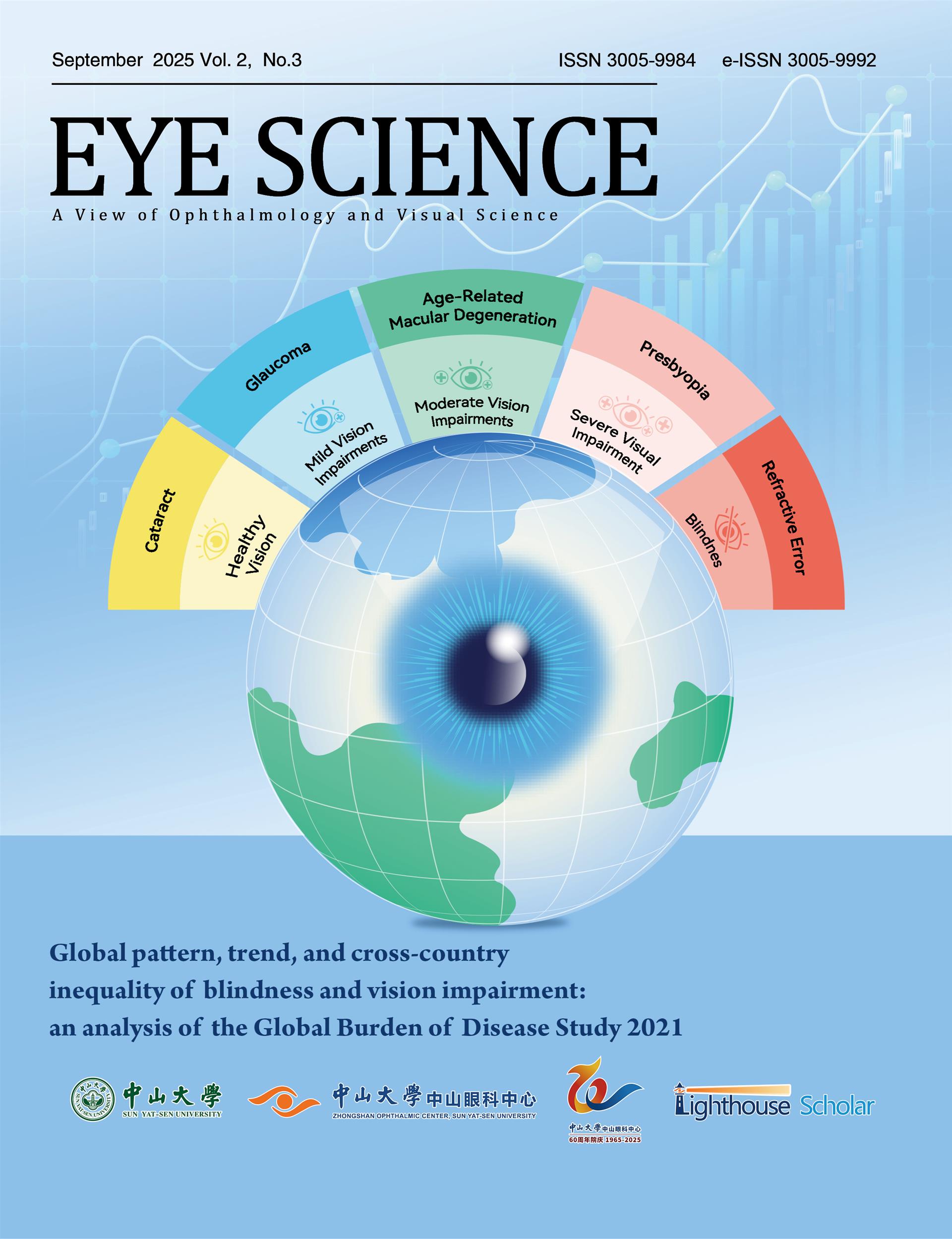
Global pattern, trend, and cross-country inequality of blindness and vision impairment: an analysis of the Global Burden of Disease Study 2021

Global pattern, trend, and cross-country inequality of blindness and vision impairment: an analysis of the Global Burden of Disease Study 2021

:211-221
 
Background: Blindness and vision impairment (BVI) continue to pose significant global public health challenges, disproportionately impacting vulnerable populations and further widening socioeconomic disparities. This study conducts a comprehensive evaluation of the global burden of BVI and the socioeconomic inequalities in its distribution from 1990 to 2021, aiming to provide insights for targeted intervention strategies. Methods: Using data from Global Burden of Disease 2021, this study performed a multiscale analysis of BVI burden, examining patterns at the global, regional and national levels. We quantified the disease burden using disability-adjusted life years DALY and prevalence rates. Temporal trends were analyzed by calculating estimated annual percentage changes (EAPC). Stratified assessments were carried out by sex and age group across 21 regions and 204 countries. The study also included comparative analyses of six major eye conditions and evaluated their associations with socio-demographic index (SDI). Results: Globally, the age-standardized prevalence of BVI increased from 12,453.52 per million (95% UI: 10,287.58-15,226.09) in 1990 to 15,784.33 per million (12,761.44-19,502.32) in 2021, with an EAPC of 1.09% (95% UI: 0.97-1.20). During this period, global DALYs attributable to BVI increased by 37.7%. Disease trends exhibited significant divergence, with near vision loss showing the steepest increase (EAPC: 1.47%), while the prevalence of glaucoma declined (EAPC: -0.73%). Geographic disparities were pronounced, with substantial improvements observed in Equatorial Guinea (EAPC: -1.75) and worsening burdens in Benin (+0.54). Disease distribution demonstrated strong regional clustering, with near vision loss being predominant in Sub-Saharan Africa (64.47%) and East Asia (50.97%), while cataract was the most common condition in Oceania (33.86%). Females consistently bore a higher burden, particularly in South Asia (646.3 vs 563.2 DALYs). Moreover, we identified a strong inverse correlation between SDI and BVI burden (ρ=-0.772 for DALYs). Conclusions: This study highlights the severe global burden of BVI and the significant cross-country inequality, particularly in low- and middle-income countries. It emphasizes the urgent need for targeted interventions and the integration of eye care into universal health policies to promote global health equity in the post-pandemic era.