Original Article

Causes and factors associated with vision impairment in the elderly population in Mangxin town, Kashgar region, Xinjiang, China

Causes and factors associated with vision impairment in the elderly population in Mangxin town, Kashgar region, Xinjiang, China

:12-24
 

Purpose: This study aimed to investigate the prevalence, causes, and influencing factors of vision impairment in the elderly population aged 60 years and above in Mangxin Town, Kashgar region, Xinjiang, China. Located in a region characterized by intense ultraviolet radiation and arid climatic conditions, Mangxin Town presents unique environmental challenges that may exacerbate ocular health issues. Despite the global emphasis on addressing vision impairment among aging populations, there remains a paucity of updated and region-specific data in Xinjiang, necessitating this comprehensive assessment to inform targeted interventions. Methods: A cross-sectional study was conducted from May to June 2024, involving 1,311 elderly participants (76.76% participation rate) out of a total eligible population of 1,708 individuals aged ≥60 years. Participants underwent detailed ocular examinations, including assessments of uncorrected visual acuity (UVA) and best-corrected visual acuity (BCVA) using standard logarithmic charts, slit-lamp biomicroscopy, optical coherence tomography (OCT, Topcon DRI OCT Triton), fundus photography, and intraocular pressure measurement (Canon TX-20 Tonometer). A multidisciplinary team of 10 ophthalmologists and 2 local village doctors, trained rigorously in standardized protocols, ensured consistent data collection. Demographic, lifestyle, and medical history data were collected via questionnaires. Statistical analyses, performed using Stata 16, included multivariate logistic regression to identify risk factors, with significance defined as P < 0.05. Results: The overall prevalence of vision impairment was 13.21% (95% CI: 11.37–15.04), with low vision at 11.76% (95% CI: 10.01–13.50) and blindness at 1.45% (95% CI: 0.80–2.10). Cataract emerged as the leading cause, responsible for 68.20% of cases, followed by glaucoma (5.80%), optic atrophy (5.20%), and age-related macular degeneration (2.90%). Vision impairment prevalence escalated significantly with age: 7.74% in the 60–69 age group, 17.79% in 70–79, and 33.72% in those ≥80. Males exhibited higher prevalence than females (15.84% vs. 10.45%, P = 0.004). Multivariate analysis revealed age ≥80 years (OR = 6.43, 95% CI: 3.79–10.90), male sex (OR = 0.53, 95% CI: 0.34–0.83), and daily exercise (OR = 0.44, 95% CI: 0.20–0.95) as significant factors. History of eye disease showed a non-significant trend toward increased risk (OR = 1.49, P = 0.107). Education level, income, and smoking status showed no significant associations. Conclusion: This study underscores cataract as the predominant cause of vision impairment in Mangxin Town’s elderly population, with age and sex as critical determinants. The findings align with global patterns but highlight region-specific challenges, such as environmental factors contributing to cataract prevalence. Public health strategies should prioritize improving access to cataract surgery, enhancing grassroots ophthalmic infrastructure, and integrating portable screening technologies for early detection of fundus diseases. Additionally, promoting health education on UV protection and lifestyle modifications, such as regular exercise, may mitigate risks. Future research should expand to broader regions in Xinjiang, employ advanced diagnostic tools for complex conditions like glaucoma, and explore longitudinal trends to refine intervention strategies. These efforts are vital to reducing preventable blindness and improving quality of life for aging populations in underserved areas.

Purpose: This study aimed to investigate the prevalence, causes, and influencing factors of vision impairment in the elderly population aged 60 years and above in Mangxin Town, Kashgar region, Xinjiang, China. Located in a region characterized by intense ultraviolet radiation and arid climatic conditions, Mangxin Town presents unique environmental challenges that may exacerbate ocular health issues. Despite the global emphasis on addressing vision impairment among aging populations, there remains a paucity of updated and region-specific data in Xinjiang, necessitating this comprehensive assessment to inform targeted interventions. Methods: A cross-sectional study was conducted from May to June 2024, involving 1,311 elderly participants (76.76% participation rate) out of a total eligible population of 1,708 individuals aged ≥60 years. Participants underwent detailed ocular examinations, including assessments of uncorrected visual acuity (UVA) and best-corrected visual acuity (BCVA) using standard logarithmic charts, slit-lamp biomicroscopy, optical coherence tomography (OCT, Topcon DRI OCT Triton), fundus photography, and intraocular pressure measurement (Canon TX-20 Tonometer). A multidisciplinary team of 10 ophthalmologists and 2 local village doctors, trained rigorously in standardized protocols, ensured consistent data collection. Demographic, lifestyle, and medical history data were collected via questionnaires. Statistical analyses, performed using Stata 16, included multivariate logistic regression to identify risk factors, with significance defined as P < 0.05. Results: The overall prevalence of vision impairment was 13.21% (95% CI: 11.37–15.04), with low vision at 11.76% (95% CI: 10.01–13.50) and blindness at 1.45% (95% CI: 0.80–2.10). Cataract emerged as the leading cause, responsible for 68.20% of cases, followed by glaucoma (5.80%), optic atrophy (5.20%), and age-related macular degeneration (2.90%). Vision impairment prevalence escalated significantly with age: 7.74% in the 60–69 age group, 17.79% in 70–79, and 33.72% in those ≥80. Males exhibited higher prevalence than females (15.84% vs. 10.45%, P = 0.004). Multivariate analysis revealed age ≥80 years (OR = 6.43, 95% CI: 3.79–10.90), male sex (OR = 0.53, 95% CI: 0.34–0.83), and daily exercise (OR = 0.44, 95% CI: 0.20–0.95) as significant factors. History of eye disease showed a non-significant trend toward increased risk (OR = 1.49, P = 0.107). Education level, income, and smoking status showed no significant associations. Conclusion: This study underscores cataract as the predominant cause of vision impairment in Mangxin Town’s elderly population, with age and sex as critical determinants. The findings align with global patterns but highlight region-specific challenges, such as environmental factors contributing to cataract prevalence. Public health strategies should prioritize improving access to cataract surgery, enhancing grassroots ophthalmic infrastructure, and integrating portable screening technologies for early detection of fundus diseases. Additionally, promoting health education on UV protection and lifestyle modifications, such as regular exercise, may mitigate risks. Future research should expand to broader regions in Xinjiang, employ advanced diagnostic tools for complex conditions like glaucoma, and explore longitudinal trends to refine intervention strategies. These efforts are vital to reducing preventable blindness and improving quality of life for aging populations in underserved areas.
Global Eye Health and Epidemiology Selection

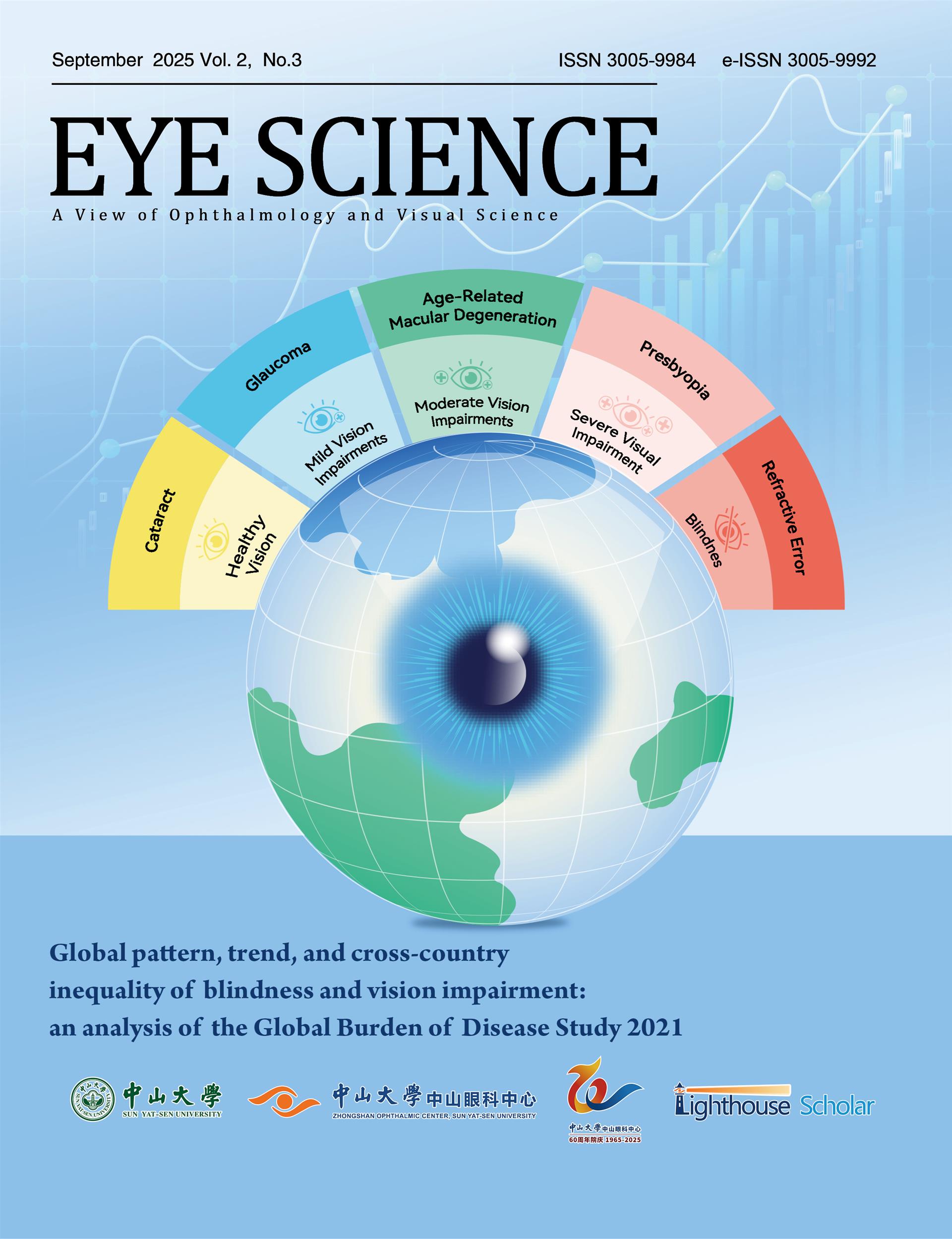
Global pattern, trend, and cross-country inequality of blindness and vision impairment: an analysis of the Global Burden of Disease Study 2021

Global pattern, trend, and cross-country inequality of blindness and vision impairment: an analysis of the Global Burden of Disease Study 2021

:211-221
 
Background: Blindness and vision impairment (BVI) continue to pose significant global public health challenges, disproportionately impacting vulnerable populations and further widening socioeconomic disparities. This study conducts a comprehensive evaluation of the global burden of BVI and the socioeconomic inequalities in its distribution from 1990 to 2021, aiming to provide insights for targeted intervention strategies. Methods: Using data from Global Burden of Disease 2021, this study performed a multiscale analysis of BVI burden, examining patterns at the global, regional and national levels. We quantified the disease burden using disability-adjusted life years DALY and prevalence rates. Temporal trends were analyzed by calculating estimated annual percentage changes (EAPC). Stratified assessments were carried out by sex and age group across 21 regions and 204 countries. The study also included comparative analyses of six major eye conditions and evaluated their associations with socio-demographic index (SDI). Results: Globally, the age-standardized prevalence of BVI increased from 12,453.52 per million (95% UI: 10,287.58-15,226.09) in 1990 to 15,784.33 per million (12,761.44-19,502.32) in 2021, with an EAPC of 1.09% (95% UI: 0.97-1.20). During this period, global DALYs attributable to BVI increased by 37.7%. Disease trends exhibited significant divergence, with near vision loss showing the steepest increase (EAPC: 1.47%), while the prevalence of glaucoma declined (EAPC: -0.73%). Geographic disparities were pronounced, with substantial improvements observed in Equatorial Guinea (EAPC: -1.75) and worsening burdens in Benin (+0.54). Disease distribution demonstrated strong regional clustering, with near vision loss being predominant in Sub-Saharan Africa (64.47%) and East Asia (50.97%), while cataract was the most common condition in Oceania (33.86%). Females consistently bore a higher burden, particularly in South Asia (646.3 vs 563.2 DALYs). Moreover, we identified a strong inverse correlation between SDI and BVI burden (ρ=-0.772 for DALYs). Conclusions: This study highlights the severe global burden of BVI and the significant cross-country inequality, particularly in low- and middle-income countries. It emphasizes the urgent need for targeted interventions and the integration of eye care into universal health policies to promote global health equity in the post-pandemic era.